A SaaS platform where clients describe their product and AI agents autonomously deliver end-to-end advertising campaigns — from strategy to production-ready assets.
Development Process
How It Was Built
The platform was designed as a Minimum Viable Agentic Company (MVAC) — 12 specialized AI agents covering every department of a real advertising agency. Development ran across 4 structured phases, each ending with a verified checkpoint before the next phase began.
Foundations
Set up the full infrastructure: database schema (Prisma + SQLite), authentication (NextAuth.js v5 with Google OAuth), message bus, risk-tier engine (P0–P5), and all 12 agent definitions.
✓ 100% CompleteMVAC Pilot
Activated the first three core automations: the A08 marketing asset pipeline (MVEP research → campaign concept), A06 customer support triage, and the full Spec-to-Ship pipeline (PRD → architecture → code → QA).
✓ 100% CompleteMVAC Stabilization
Built the service catalog, MCP tool allowlist, GDPR-compliant RoPA dashboard, and hardened the message bus with retry logic, exponential back-off, and a dead-letter queue.
✓ 100% CompleteReliability
Added an evaluation harness (3 suites × 3 cases, keyword scoring, drift detection), incident management with Claude-generated postmortems, per-agent cost budgets, and live drift monitoring banners.
✓ 100% CompleteTechnology Stack
Core Concept
A Company Run by AI Agents
The central idea of this project is not just AI-assisted tooling — it is a complete company architecture where 12 specialized AI agents handle every department: executive strategy, compliance, engineering, QA, marketing, sales, and customer support.
Each agent has a defined role, a primary tool (Claude Cowork or Claude Code), a set of outputs it is responsible for, and a risk tier that determines how much autonomy it gets. Agents communicate via a typed message bus using a structured schema (REQUEST → PLAN → APPROVE → EXECUTE → VERIFY) so every decision is traceable.
Human gatekeepers only appear at P4/P5 risk levels — for client-facing decisions, financial actions, or production deployments. Everything below that threshold runs autonomously.
When a client submits a campaign, the chain looks like this: A01 (CEO) sets the priority and publishes a REQUEST → A02 (Chief-of-Staff) writes the brief and runs market research → A08 (Marketing) generates the campaign concept, visual mockups, and storyboard → A05 (Product Manager) writes acceptance criteria → A10 (Builder) ships any code changes → A11 (QA) validates → A03 (Compliance) checks legal constraints before anything goes external.
The same orchestration applies internally: feature requests go through Spec-to-Ship (A05 → A09 → A10 → A11), support tickets go through A06 triage, and cost/quality metrics are continuously monitored by the eval harness.
Client Campaign Flow
The 12-Agent Roster (MVAC)
| ID | Agent | Type | Primary Tool | Key Output | Max Risk |
|---|---|---|---|---|---|
| A01 | Strategy / CEO Agent | Executive | Claude Cowork | OKRs, priorities, decision memos | P5 |
| A02 | Chief-of-Staff / Program Agent | Operator | Claude Cowork | Weekly plan, RAID log, research briefs | P3 |
| A03 | Policy & Compliance Guardian | Guardian | Cowork + API | Policies, GDPR approvals, risk registers | P5 |
| A04 | Security Guardian | Guardian | Claude Code | Permission policies, security reviews, incident stop-the-line | P5 |
| A05 | Product Manager Agent | Analyst | Claude Cowork | PRDs, acceptance criteria, release briefs | P3 |
| A06 | Customer Support Triage Agent | Customer-facing | Cowork + API | Ticket responses, bug reports, KB drafts | P4 |
| A07 | Sales Agent (SDR + AE) | Customer-facing | Claude Cowork | Outreach sequences, proposals, deal memos | P4 |
| A08 | Marketing / Growth Agent | Operator | Claude Cowork | Campaign concepts, visuals, storyboards, bundles | P3 |
| A09 | Engineering Lead / Architect Agent | Executive | Claude Code | ADRs, technical plans, PR review & merge decisions | P4 |
| A10 | Full-Stack Builder Agent | Builder | Claude Code | Feature PRs, bug fixes, tests | P3 |
| A11 | QA / Test Automation Agent | Builder | Claude Code | Test plans, regression suite, quality reports | P3 |
| A12 | People & Money Ops Agent | Operator | Claude Cowork | Budget drafts, hiring ops, vendor notes | P4 |
Risk Tier Model (P0–P5)
Every agent action is classified by risk level. Higher tiers require progressively more oversight — from fully autonomous reads (P0) to explicit human sign-off for production deployments and contracts (P5).
Platform Walkthrough
What Was Built
Four views that cover the full scope — from internal agent operations to the client-facing campaign workflow.
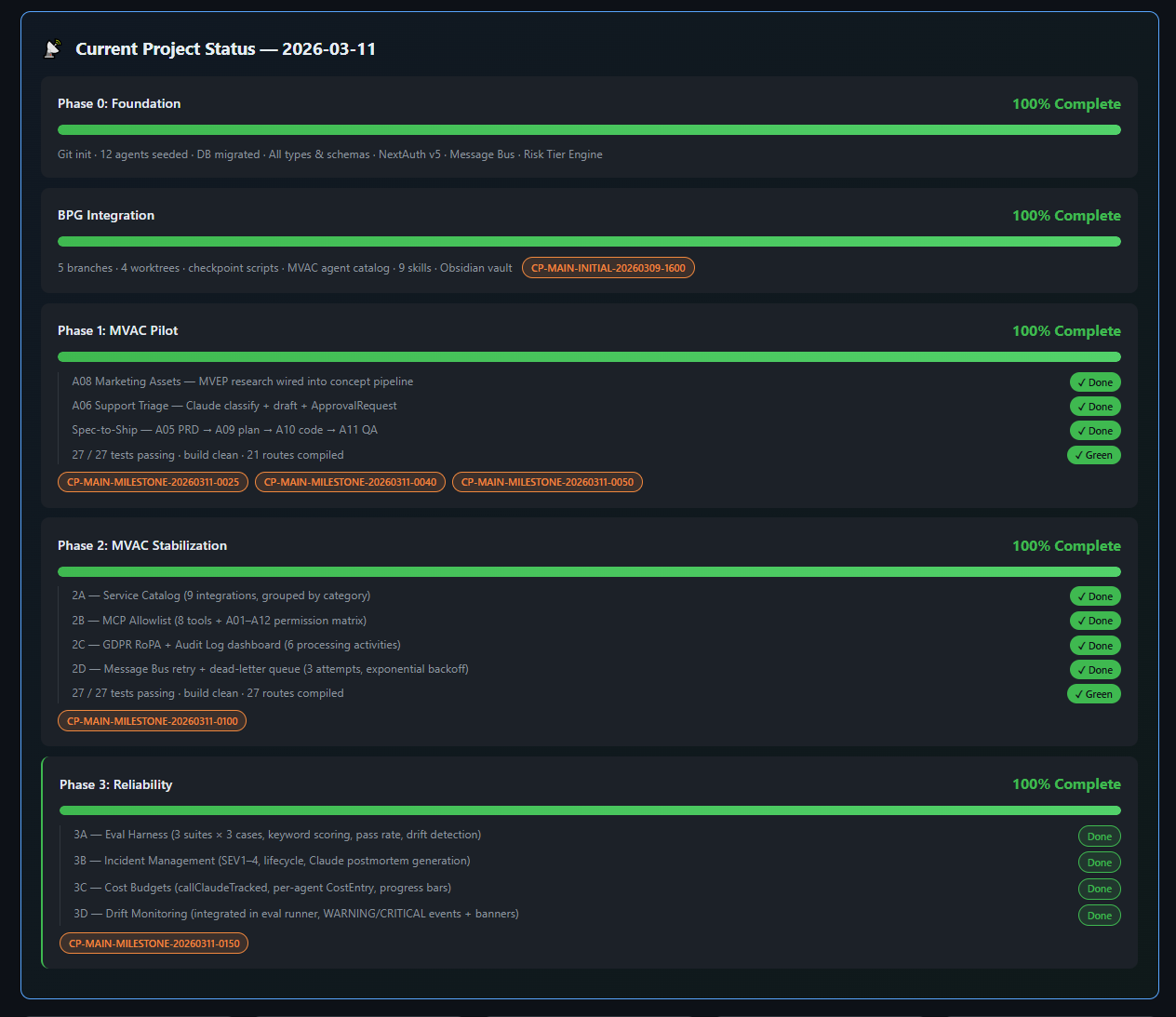
All 4 Phases Delivered at 100%
The project status board tracked every milestone in real time. Each phase ran in its own git worktree with signed checkpoint tags (CP-MAIN-MILESTONE-*). The dashboard displays progress bars, sub-task completion, and the checkpoint tag that locked in each phase — providing full auditability of what was shipped and when.
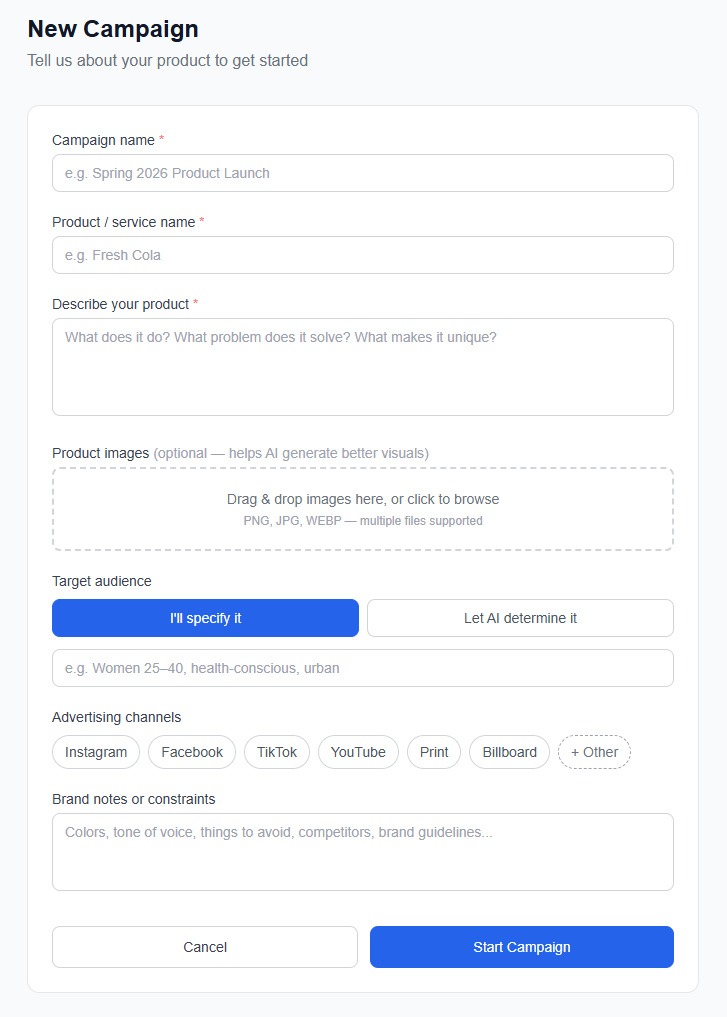
Campaign Creation in One Form
Clients start by describing their product, uploading reference images, picking target channels (Instagram, TikTok, YouTube, Billboard…) and specifying brand constraints. The form feeds directly into the agent pipeline — no sales call, no briefing meeting. The AI asks any remaining clarifying questions inside the portal chat.
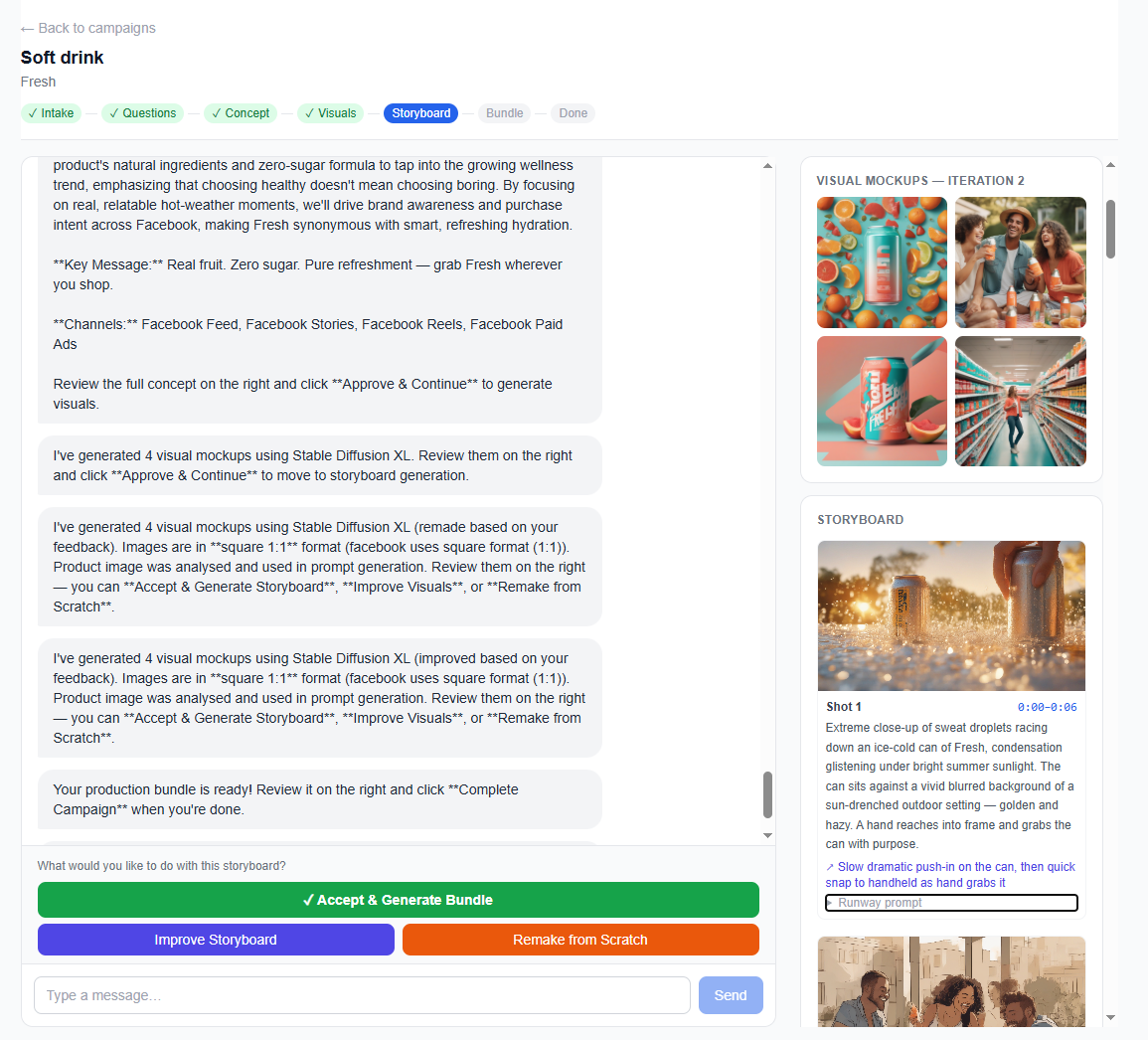
Chat-Driven Campaign Workflow
A 7-step progress bar (Intake → Questions → Concept → Visuals → Storyboard → Bundle → Done) guides the client through the full campaign. At each stage the AI presents work in the chat panel and renders outputs — visual mockups, storyboard shots — in the right-hand preview panel. Clients can accept, request improvements, or remake from scratch at any step.
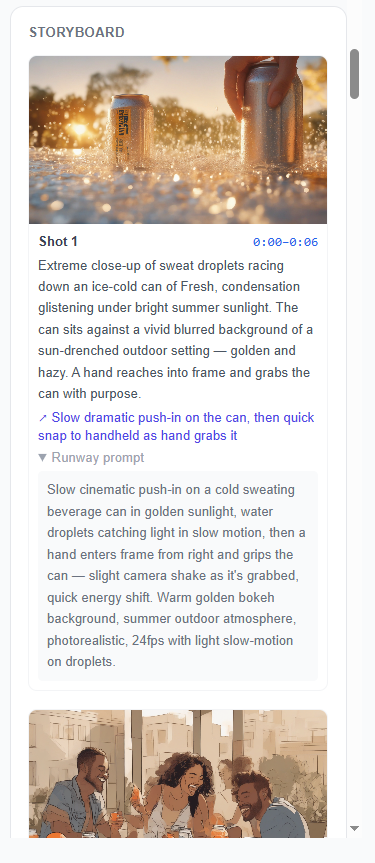
Video-Ready Shot Cards with Runway Prompts
Each storyboard frame includes a generated image, a visual description, exact timing (e.g. 0:00–0:06), a camera movement note, and a collapsible Runway prompt ready to paste into an AI video tool. The 5-shot structure covers a full 30-second commercial in landscape (16:9) or portrait (9:16) format based on selected channels.
Results Achieved
What We Delivered in 90 Days
Starting from an empty repository, the platform reached a fully operational state across all four planned phases within the target 90-day window.
Full Agentic Campaign Pipeline
From product description to storyboard with Runway prompts — fully automated, no human copywriter or art director required.
AI Visual Generation
Product image analysis feeds into every prompt. Stable Diffusion XL generates channel-correct formats (1:1, 9:16, 16:9) with DALL-E 3 as fallback.
GDPR-Compliant by Design
Record of Processing Activities (RoPA), Data Flow Diagrams, and P0–P5 risk tiers enforce German/EU compliance automatically.
Reliability Monitoring
Eval harness with drift detection (WARNING ≥20%, CRITICAL ≥40%), per-agent cost budgets, and Claude-generated incident postmortems.
Spec-to-Ship Automation
A05 writes the PRD, A09 produces the technical plan, A10 generates code, A11 writes the test plan — all triggered by a single form submit.
Message Bus with Retry Logic
Dead-letter queue with 3 attempts and exponential back-off ensures no inter-agent message is silently lost under failure conditions.